3. Integrated Coastal Zone Management cycle
ICZM is a stepwise, iterative and circular process. Iterative because during any step it may turn out that one of the previous steps was insufficient, that preconditions or perceptions have changed. As consequence, steps may have to be modified or repeated. Circular because finishing all steps causes an improved understanding of the coastal system, its drivers and interactions. This may open new opportunities and/or a better awareness of threats and risks and may require to run the ICZM process again. Further, after some time, new uses, pressures or measures may occur and may make a new ICZM process necessary. Traditionally an ICZM cycle contains the following steps: Initiation, Planning, Implementation as well as Monitoring and Evaluation (1).
This traditional view of an ICZM as a circular and iterative process is still valid. However, it turned out that this approach is too vague to be suitable for practical applications and that it was hardly concrete enough for local case studies. As consequence, the Systems Approach Framework (SAF) has been developed.
Systems thinking is the process of understanding how things influence one another within a whole. It is defined as “an approach to problem solving, by viewing ‘problems’ as parts of an overall system, rather than reacting to specific parts, outcomes or events and potentially contributing to further development of unintended consequences. It focuses on cyclical rather than linear causes and effects” (3).
The Systems Approach Framework builds upon systems thinking and provides a stepwise guide to sustainable ICZM. It is meant to overcome a major weakness of the traditional ICZM process and shall allow shortening the time between recognition of a problem until the implementation of a sustainable solution. The SAF itself as well as all 6 steps are documented in an online handbook (2). This entire chapter strictly follows and reflects its content.
According to Tom Hopkins (2011), the SAF is “a framework to allow a team to develop a management strategy; based on interaction between science, policy and stakeholders; multidisciplinary and stringent in its application.”
The SAF is not a tool in itself; a replacement for legislation; a quick exercise; something that can be implemented by a single person
Aim of the SAF is to “develop and test a structure for processing and evaluating multidisciplinary and trans-disciplinary information to enable environmental managers and policy-makers make sustainable solutions concerning the coastal zone, in order to improve ecological sustainability, economic efficiency, and social equity” (3).
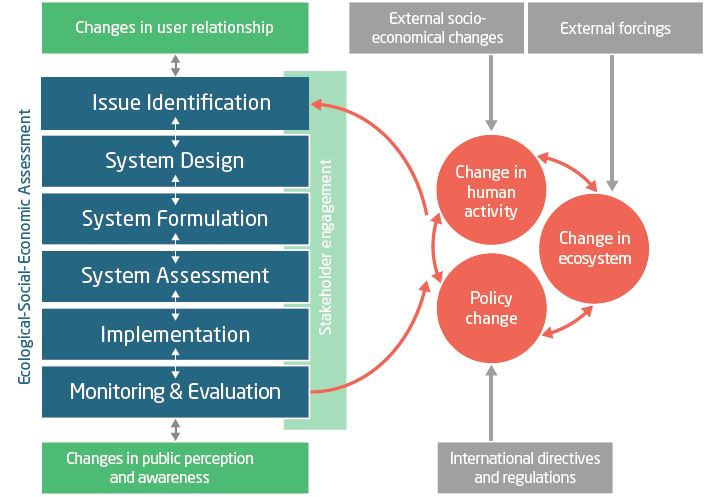
The SAF guides the ICZM process in 6 steps:
- Issue Identification
- System Design
- System Formulation
- System Assessment
- Implementation
- Monitoring & Evaluation
The Ecological-Social-Economic (ESE) Assessment is the core of the SAF (blue boxes in the figure) is conducted in collaboration with stakeholders throughout all the steps. A SAF application from Issue Identification to Implementation can be conducted within 12 to 18 months with an experienced team.